Why are heat pumps expensive despite being efficient?
The concept of utilising heat pumps for heating has been around for hundreds of years, and yet, despite this, domestic heating has been dominated by fossil fuels. Figure 1 illustrates the makeup of England’s central heating in terms of resources in 2025 based on ONS data. Mains gas was the most favourable resource, accounting for 78.6% of properties. In 2021, domestic heating in the UK accounted for 18% of all UK greenhouse gas emissions. With the drive towards net-zero greenhouse gas emissions in 2050, a drastic reduction in the utilisation of fossil fuels for domestic heating will be required. Although there is the possibility of utilisation of hydrogen gas as a fuel for heating, this comes with a unique set of challenges, and widespread adoption in the UK at present looks unlikely. This leaves the options of directly using renewable resources for heat or electrically generated heat.
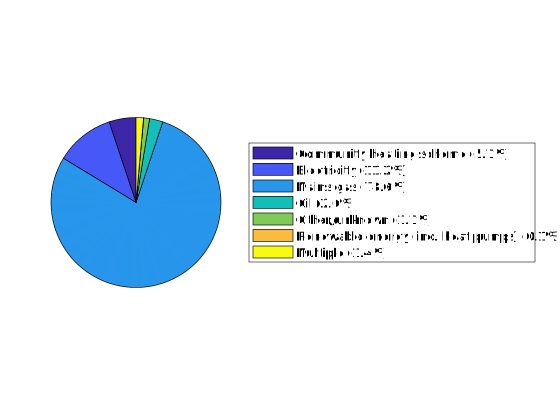 Figure 1. Englands’s central heating resource mix 2025.
Heat pump operation and efficiency
Heat pumps operate by the same principles as an air-conditioner, only with a reversing valve, which allows the unit to transfer heat into a property in addition to out of a property. Energy is extracted either from the ground or air and moved into the property, utilising a refrigerant liquid to be dissipated as heat. Air-source heat pumps are like air-conditioning units in terms of features, whereas ground-source heat pumps require large boreholes or trenches to house pipes in addition to the heat pump unit.
Johnson Controls’ white paper states that air-source heat pumps have a high efficiency of 300-400% compared to fossil fuel-fired appliances such as gas boilers, which have efficiencies of up to 95%. This means that for every 1 kWh of electricity, a heat pump produces 3-4 kWh of heat. Being three to four times more efficient than the gas counterparts may suggest they would be less expensive to run, though this is currently not the case due to a disparity in electricity and gas prices, with the current Ofgem price cap indicating average costs of 28p/kWh for electricity and 6p/kWh. Without other smart devices such as solar or battery energy storage, the present high cost of electricity compared to gas makes the running costs of a heat pump marginal compared to gas boilers in most cases.
Boiler Upgrade Scheme
The present government policy is most strongly supporting the installation of air-source heat pumps through the Boiler Upgrade Scheme (BUS). The scheme offers £7,500 for households in England and Wales towards the installation of a heat pump. This scheme brings the costs of installing an air-source heat pump and gas closer, with a general figure being £11,000 for a heat pump and £4,000 for a gas boiler. The cost of a ground-source heat pump is typically significantly greater at £29,000, meaning that the scheme does little to compensate for this type.
The government announced in January 2026 that the BUS will be extended by a further year to 2029/30; however, funding for the Energy Company Obligation (ECO) scheme, which aimed to improve the insulation of homes, will end in December 2026.
Emissions reduction example
A heat pump will have indirect greenhouse gas emissions based on the source of electricity which supplies it. Although the emissions associated with electricity can vary wildly with different suppliers, as explained in this article, utilising a national average of CO2 emissions per unit of energy, a comparison can be made between the emissions of a gas boiler and heat pumps.
Assuming a two-to-three-bedroom (and person) property, then an average gas usage per annum is 11,500 kWh. A heat pump with an efficiency of 300% would make an equivalent electricity consumption for heat of 3,833 kWh. Using multipliers of 244 gCO2/kWh for natural gas, and 205 gCO2/kWh for electricity will result in 2,806 kg versus 785.8 kg of CO2 per year, respectively. This considers the 2025 generation mix, which produces a 72% reduction in emissions. The government is targeting 50 gCO2/kWh in 2030, though, which would achieve a 93% reduction in emissions. The present reduction in greenhouse gas emissions that can be achieved using heat pumps is clear, and this is set to further improve in future.