The most significant renewable energy project that wasn't built: the Severn Estuary barrage
As Great Britain accelerates its transition away from fossil fuels, policymakers and engineers are increasingly asking how to deliver large-scale, reliable, low-carbon electricity in a system dominated by weather-dependent generation such as wind and solar. The Severn Estuary barrage tidal scheme remains one of the most ambitious proposals despite first being proposed as far back as 1925 (by Lord Brabazon). Back then, it was not followed up due to the outbreak of World War II, but was researched significantly during the 1970s and 80s, primarily due to the oil crisis. In total, almost 30 variations of a tidal scheme on the Severn Estuary have been proposed to date.
The harnessable tidal energy is dictated by the tidal range; the Severn Estuary has the second-highest in the world, making it a unique site. By placing turbines in a large dam-like structure across the estuary, water flowing in and out with the tides could be harnessed to drive turbines and generate electricity without burning fuel, producing no greenhouse gas emissions during operation.
Output potential
The most significant investigations into the barrage determined it could deliver 5% of the UK’s current electricity demand, or up to 8.64 GW, from a fully predictable, zero-carbon source. This was amongst other major studies though, as summarised in Figure 1. Unlike wind and solar, tidal power is extraordinarily reliable: tidal heights and timings can be predicted decades in advance, giving a unique consistency to combat the intermittency of most renewable energy resources.
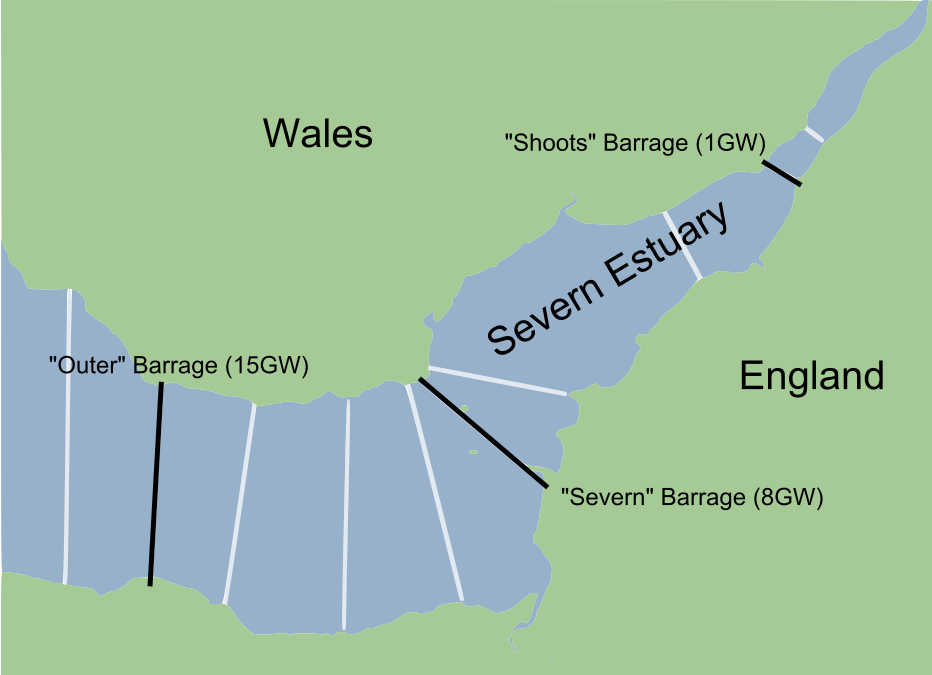 Figure 1. Severn Estuary barrage proposals.

Economic and strategic advantages
Beyond decarbonisation, the barrage has potential economic and strategic benefits:
Energy security: because the barrage relies only on the tides, it is independent of fuel imports and volatile global markets, lowering dependence on natural gas. Once constructed, operating costs are low and stable, and the lifespan is long, helping insulate consumers from fluctuating energy prices.
Local economy support: large-scale construction and long-term maintenance could create thousands of jobs, particularly in South Wales and southwest England.
Flood protection: a barrage can double as a storm surge barrier, offering some protection against sea-level rise and coastal flooding which could become more pressing due to climate change.
Cross-estuary connectivity: the structure could support transport links (road and rail), potentially improving connectivity between England and Wales.
Environmental and practical considerations
However, the barrage is not without controversy. Environmental groups have raised serious concerns about loss of intertidal habitat, impacts on fish and bird species, and disruption of the estuary’s natural dynamics. Large sections of internationally protected wetlands could be affected, with implications for biodiversity and conservation commitments.
These ecological costs partly explain why alternative approaches, such as tidal lagoons or tidal stream technologies, have gained comparatively more political traction in recent years; the Severn Estuary Commission, in a 2025 report, recommended smaller lagoon projects to avoid crossing the entire estuary and have lower environmental impacts.
There are also practical questions about cost and financing. Cost estimates vary, but could be in the region of £33.4 bn for the full barrage or £6.8 bn for the smaller 1.05 GW Shoots Barrage. While some advocates argue that the project could yield electricity at competitive prices once capital costs are recovered, securing funding and navigating regulatory hurdles would be challenging.
The future of power on the Severn Estuary
The Severn Barrage and its variations encapsulate both the promise and complexity of Britain’s renewable energy future. Their potential to deliver predictable, zero-carbon electricity at scale aligns strongly with national decarbonisation goals. Yet, the environmental trade-offs and upfront costs mean that serious planning, stakeholder engagement, and innovative design solutions are essential if it is ever to move beyond concept to reality. Whether through a full barrage, a series of lagoons, or emerging tidal technologies, the Severn Estuary remains a unique natural resource that could play a meaningful role in the UK’s transition to a low-carbon power system provided that ecological factors are not ignored.