Liquid air energy storage: A scalable long-duration solution for a low-carbon Britain
As Great Britain accelerates its transition away from fossil fuels, policymakers and engineers are increasingly asking how to deliver large-scale, reliable, low-carbon electricity in a system dominated by weather-dependent generation such as wind and solar. Long-duration energy storage is emerging as a critical enabler of this transition.
A potential solution pioneered by Highview Power, a London-based company, is liquid air energy storage (LAES). It offers an alternative to more mature and widely deployed storage technologies, such as pumped hydro and lithium-ion batteries.
Projects
Currently, Highview’s only operational grid-scale LAES is a 5 MW / 15 MWh plant in Bury, near Manchester.
Their first commercial-scale operation is under construction in Carrington, Greater Manchester. Scheduled for completion in 2026, it will deliver 50 MW / 300 MWh of storage capacity.
Beyond this, Highview plans to ramp up significantly, with a targeted 2027 operating date for a 300 MW / 3.2 GWh plant in Hunterston, North Ayrshire. Further large-scale projects are expected to be eligible for Ofgem’s cap and floor mechanism, a regulatory framework designed to reduce revenue risk for long-duration energy storage assets.
How it works
LAES uses off-peak, low-cost, sustainable electricity to liquefy atmospheric air, which is then stored in insulated tanks at cryogenic temperatures (around −194 °C).
Components such as carbon dioxide, water vapour and hydrocarbons are removed during the liquefaction process due to their higher solidification temperatures. This prevents blockages within the cryogenic system. Theoretically, this separation step could allow integration with direct-air carbon capture if coupled with a suitable storage solution, though this has not yet been demonstrated commercially.
When electricity is required, the liquid air is pumped to high pressure, evaporated, and heated. The resulting high-pressure gas expands through a turbine, driving a synchronous generator to produce electricity. This process is summarised in Figure 1.
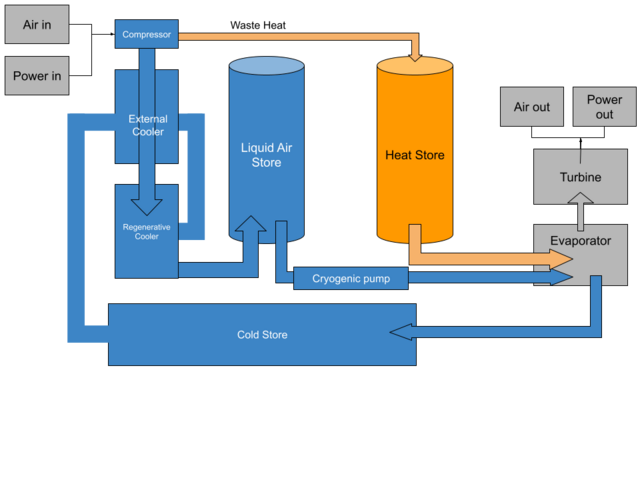 Figure 1. Liquid air energy storage process diagram.

Why LAES is different from existing storage
LAES presents several distinctive advantages:
- Long-duration capability. Suitable for storage from hours to multiple days due to its very low self-discharge rate (of as little as 0.05% per day).
- Comparable efficiency to pumped hydro. Round-trip efficiencies of around 60% have been reported, particularly when waste heat and cold recovery are integrated.
- No geographical constraints. Unlike pumped hydro, LAES does not require mountainous terrain or large water reservoirs.
- Scalable and modular. Plants can be configured according to system requirements.
- Mature engineering components. Uses established cryogenic and turbomachinery technologies rather than electrochemical materials such as lithium.
- Synchronous grid coupling. The turbine-generator system provides rotational inertia and variable reactive power support.
- No electrochemical cycling degradation. Performance does not degrade in the same way as lithium-ion batteries over repeated cycles.