How sustainable is your electricity supplier?
Electricity suppliers are mandated under their licence conditions to publicly share where they purchase power from to sell to their customers under The Electricity (Fuel Mix Disclosure) Regulations 2005. Despite this, it is apparent that only suppliers with good credentials make this information clear, typically in their marketing campaigns, with many comparison or suppliers websites obfuscating where suppliers purchase their power from. This article aims to remove these barriers and provide a simple comparison of all electricity suppliers in Great Britain (GB).
A brief history of the GB generation mix
The sources of electricity in Great Britain (GB) which supply demand, referred to as the generation mix, have undergone significant changes over the past 50 years, with the 1980s and 1990s marking a shift from a predominantly coal-based power supply to one based on natural gas. Although not a reason for the shift, this had an impact on emissions since, in terms of CO2, coal produces 919 g/kWh compared with natural gas, which produces 382 g/kWh. Since the 2010s, a drive to increase zero-emission resources such as renewable and (significantly less so) nuclear energy has occurred. Under the government’s Clean Power 2030 Action Plan, it is anticipated that 95% of electricity demand will be from clean resources, reducing the overall CO2 emissions intensity to 50 g/kWh. To achieve this, the energy transition away from fossil fuel-based resources will need to accelerate even more quickly. The fuel mix of GB electricity from 2024-2025 is illustrated in Figure 1. Note that coal still holds a significant portion at 6% since this considers imports from European markets, which, unlike GB, still depend in part on coal for electricity.
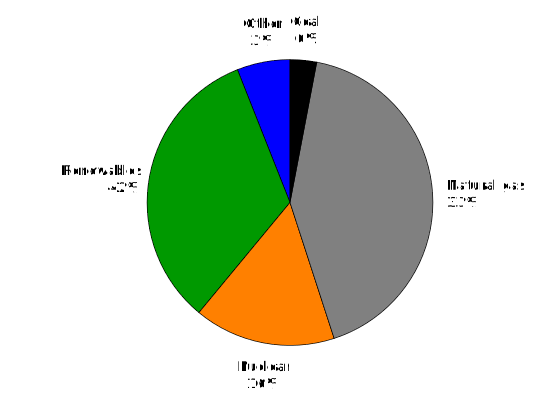 Figure 1. Great Britain’s average generation mix between April 1, 2024 to March 31, 2025.
Electricity supplier fuel mixes
Although the electricity utilised in homes and businesses is not provided by a specific generator, rather an “electricity pool” represented by a national average, as in Figure 1, suppliers do purchase specific units of energy from individual generators to then sell to consumers. This means that consumers with suppliers that only purchase renewable energy directly subsidise renewable energy infrastructure rather than fossil fuel-fired generation. For comparison purposes, the resource data from all GB electricity suppliers has been collated in Table 1.
Table 1. Electricity supplier resource allocation percentages between April 1, 2024 to March 31, 2025 ranked from low to high in terms of associated greenhouse gas emissions.
| Supplier | Coal | Natural gas | Nuclear | Renewables | Other |
|---|---|---|---|---|---|
| Scottish Power (green tariff) | 0 | 0 | 0 | 100 | 0 |
| E.ON | 0 | 0 | 0 | 100 | 0 |
| Good Energy | 0 | 0 | 0 | 100 | 0 |
| So Energy | 0 | 0 | 0 | 100 | 0 |
| Ecotricity | 0 | 0 | 0 | 100 | 0 |
| 100Green | 0 | 0 | 0 | 100 | 0 |
| Octopus | 0 | 0 | 13.6 | 86.4 | 0 |
| British Gas | 1 | 8 | 55 | 35 | 1 |
| EDF | 4.2 | 21 | 54.8 | 18.2 | 1.8 |
| Outfox | 3.4 | 39.3 | 13.9 | 40.8 | 2.6 |
| Home Energy | 3.4 | 39.3 | 13.9 | 40.8 | 2.6 |
| Sainsbury’s Energy | 10.2 | 51.5 | 2.7 | 31.3 | 4.3 |
| E.ON Next | 10.2 | 51.5 | 2.7 | 31.3 | 4.3 |
| Scottish Power (non-green tariff) | 14 | 73 | 4 | 3 | 6 |
| OVO | 15 | 73 | 4 | 2 | 6 |
| Tulo | 14.8 | 74.7 | 3.9 | 0.3 | 6.3 |
| Utility Warehouse | 15 | 75 | 4 | 0.3 | 6 |
| Utilita | 15 | 75 | 4 | 0 | 6 |
| E | 15 | 75 | 4 | 0.3 | 6 |
Many suppliers are leading the way in terms of generation mix, surpassing the GB average in Figure 1. The first six depend on entirely on renewable energy. The first seven solely use zero-emission resources. Scottish Power (SP) are the only supplier to offer a “green” and “non-green” option. It is clear from Figure 2, though, that some suppliers have a long way to go, being significantly above the GB average of CO2 emissions at 205 g/kWh.
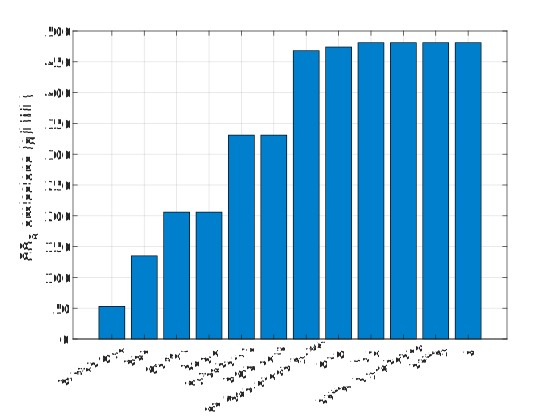 Figure 2. Electricity supplier’s emissions (where non-zero) between April 1, 2024 to March 31, 2025.