Curtailment costs: paying for electricity you do not use
Great Britain (GB) is expected to heavily decarbonise its electricity supply by 2030, as set out by the National Energy System Operator (NESO) in the Clean Power 2030 report. It is anticipated that this decarbonisation will be driven by renewable inverter-based resources such as wind and solar power, displacing conventional thermal power stations. One challenge associated with a low-carbon generation mix is the intermittency of supply and lack of monodirectional, predictable power flows at the transmission system level. The present transmission system was built to accommodate large fossil fuel-driven generation at specific locations; this topology does not align with a shift to predominantly offshore wind, and other generators remote from existing equipment.
The cost and requirement for curtailment
Where transmission capacity cannot be securely managed, generation is curtailed at a cost to the consumer. Curtailment can be for different reasons; however, the simplest and most common are thermal constraints, where the generators which should be producing power are told not to because the system around it is already at its maximum current carrying capacity. The market works such that the units of electricity that would have been generated, were the generator not curtailed, are still paid for, even though they are not used. As demand and generation need to be met continuously in realtime, this power must be purchased from elsewhere, generally from dispatchable equipment such as combined cycle gas turbines. In effect, one unit of electricity is paid for twice, and the first unit is not utilised at all when curtailments are made. These costs are all subsidised by the consumer. NESO currently report annual constraint costs approaching £2 billion, as displayed in Figure 1, and estimates in the Clean Power 2030 report that these costs may increase to £12.7 billion in 2030 without interventions.
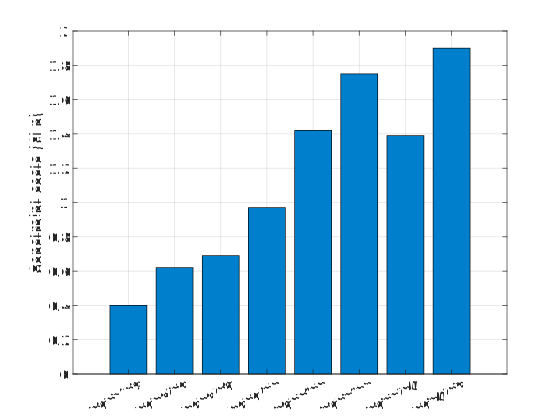 Figure 1. Great Britain’s annual electricity transmission constraint costs 2017-2025.
Mitigations for future curtailment costs
Constraints are managed at boundaries; an example is the Anglo-Scottish boundary, which accounts for a significant portion of the annual constraint costs. This boundary consists of two AC overhead line double circuits and the Western Link, which is an high voltage direct current subsea interconnection between Wales and Scotland via the Irish Sea. The ratings of these circuits sum to make the total boundary transfer capacity.
Network reinforcement
Increasing the rating of constraint boundaries will reduce the likelihood of constraints occurring at this boundary. This means that new circuits need to be constructed, be it overhead lines or underground cables. Although public opinion of overhead lines is poor, they are the most cost effective option, being five to six times less expensive than underground cables. Furthermore, underground alternating current cables are limited in length due to their technical characteristics. Overhead lines are also challenging to secure consent for, with large access areas being required for maintenance and construction. Due to these challenges, transmission operators currently have five high voltage direct current interconnections between England and Scotland, routed through the North Sea, in the development or construction phase.
Energy storage and conversion
An alternative mitigation of curtailments could be to utilise energy storage devices, such as batteries, local to the generation connection. These devices charge up during times when generators would normally be curtailed, and then, during generation troughs, they could export to the grid. Alternatively, the electricity could be used to produce green hydrogen via electrolysis. This would ensure that transmission equipment was not overloaded and would prevent energy from being wasted, but would still require electricity to be purchased from alternative sources when the energy conversion/storage devices were being used. Currently, there is no coordination between energy conversion/storage systems and generation to capitalise on these possibilities, mainly because there is no incentive to do so.