HVDC transmission, and why it is the key enabler of a just transition in Great Britain
High-voltage direct current (HVDC) electricity transmission is a method of transporting large volumes of power, which is rapidly evolving in Great Britain (GB) due to changing factors such as geography and the intermittency of renewable energy generation. The electricity system in GB has utilised high-voltage alternating current (HVAC) transmission since its inception, whereby generators, through their natural rotation, produce a sinusoidal waveform varying between maximum positive and negative values 50 times per second (50 Hz). AC is simple to step up or down, utilising transformers and is the electricity supplied to all GB homes and businesses.
The benefits of HVDC
AC is not perfect for all applications, though, since due to its alternating nature, it is effectively continually charging and discharging the equipment it is connected to, and the energy requirement to do so is termed reactive power. Reactive power is tied to system voltage, where capacitive reactive power increases voltage and inductive reactive power sinks system voltage. The nature of cables in the power system can be likened to capacitors, containing a dielectric insulating medium separating two conductors (one current-carrying, and one an earthed armour). Capacitive reactive power in HVAC cables is directly tied to length and operating voltage; a long cable produces significant reactive power and increases system voltage. This is not a desirable effect in many scenarios and may push voltage outside of controllable limits. Additionally, depending on length, the entire current-carrying capacity of the cable could be taken up by reactive current before any active power is transported, making the cable redundant.
A further drawback of utilising AC is the skin effect, whereby the alternating current within the conductor also produces an alternating magnetic field, forcing the current flow to oppose itself electromagnetically, resulting in the centre of the conductor carrying minimal current and the circumference of the conductor having a much higher current density. This is one reason why AC cables tend to be composed of multiple smaller conductors rather than a single cross-section.
DC cables eliminate reactive power and the skin effect, since the voltage waveform of DC is a fixed voltage. After initial charging on circuit energisation, no further charging or discharging occurs. This means that not only does the circuit have lower losses than the AC equivalent, but it can travel further distances and have a lower conductor size. These benefits are at the expense of a converter station at each end of the cable, transforming AC to DC and then DC back to AC.
HVDC topology
Many options have been developed for HVDC transmission, limited by the ratings of the semiconductors required. For instance, until recent years, line commutated (also referred to as current source) converters dominated the market, using thyristor valves, because these had high current ratings compared to insulated gate bipolar transistors (IGBTs), which are used in voltage source converters. Line commutated converters have significant disadvantages, despite having higher ratings; they are dependent on a strong AC network connection, cannot be used in a black start event, and require reactive power compensation equipment.
The link itself can be composed of different cables and converter topologies as displayed in Figure 1. Monopole refers to a single converter at each end of the link; bipole refers to two at each end, operating at positive and negative voltages. Like all DC circuits, a positive and a negative are required; for a monopole system, a positive cable can be used in tandem with a negative cable for symmetrical monopole or ground return electrodes or cables for asymmetrical monopole. Ground return is not permitted for GB systems due to environmental concerns. Likewise, for a bipole system, a positive and negative cable are always required, and a dedicated metallic return cable connected to the neutral bus at each end (or ground return electrodes in other countries) can be used. Where no metallic return is used, the system is termed a rigid bipole; this topology is frequently selected.
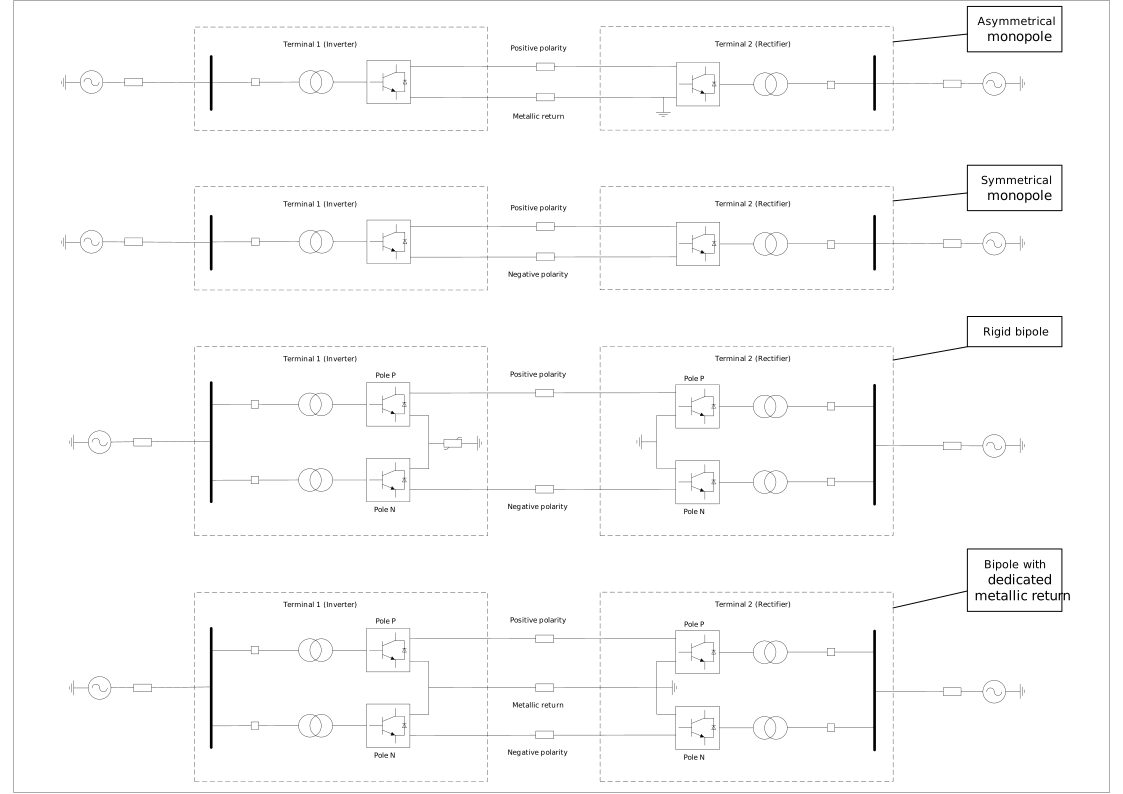 Figure 1. Schematic of four common HVDC converter topologies.
For monopole systems, a converter or cable fault results in the entire link being unusable until the fault is resolved. For bipole with a metallic return, a single cable or converter fault reduces capacity to 50% after reconfiguration. For a rigid bipole, a converter fault results in 50% capacity, but a cable fault results in the link being unusable due to no current return path being available. This represents a trade-off between cost, availability, and fault tolerance.
Why is HVDC becoming so prevalent?
HVDC in GB is becoming central to decarbonisation for multiple reasons. Firstly, for internal system interconnection, it allows the bulk transfer of power from remote, renewable resource-rich areas to demand centres, without the need for onshore infrastructure, since the cables can be carried subsea. This internal infrastructure will allow renewable energy connection projects to advance more quickly and allow constraint costs to be minimised. Although this makes installation and maintenance challenging, it simplifies consenting and improves public perception when compared to onshore HVAC overhead lines. Secondly, for external system interconnection, it counters the intermittency of generation by connecting two asynchronous systems, opening the potential for imports and exports due to either peaks and troughs of low carbon generation or capitalising on more inexpensive markets, lowering customer bills. National Grid estimated that interconnectors in GB delivered £1.65 bn of benefit to consumers, with 86 TWh of reduced cost electricity between 2023 and 2026. They also bring technical jobs to remote areas, supporting local economies.